RFID vs Traditional Hotel Door Locks: Which System Fits Modern Hotels?
Choosing the right hotel door lock system affects more than room security.
It can influence guest convenience, front desk efficiency, staff access, maintenance, credential management, and how easily a property can scale or integrate with other hotel technologies.
For many hotels and resorts in the Philippines, the decision often comes down to two approaches: traditional mechanical door locks and RFID-based electronic hotel locks.
Traditional locks remain familiar and simple. RFID hotel lock systems introduce electronic credentials, software-based access management, and more flexibility for hotel operations.
Neither option should be chosen based only on appearance or upfront cost. The right system depends on the property, number of rooms, operational requirements, security policies, guest expectations, and future plans.
This guide compares RFID vs traditional hotel door locks and explains which system may fit different types of modern hotels.
What Are Traditional Hotel Door Locks?
Traditional hotel door locks generally use a physical mechanical key.
The guest receives a key during check-in and uses it directly in the door lock.
The basic access process is simple:
Mechanical Key → Door Lock → Room Access
Traditional locks do not normally require lock management software, RFID cards, encoders, or electronic credentials.
For smaller properties with limited rooms and straightforward operations, this simplicity may still be practical.
However, traditional keys also require hotels to manage physical key control carefully.
What Is an RFID Hotel Lock System?
An RFID hotel lock system uses electronic credentials instead of relying only on a mechanical key.
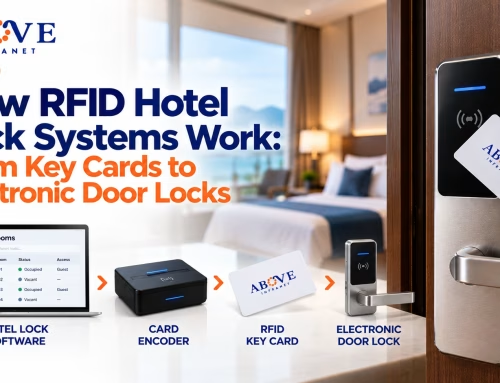
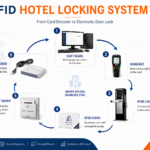
A typical system may include hotel lock management software, a card encoder, RFID key cards, electronic door locks, staff credentials, emergency override methods, and optional hotel software integrations.
The basic workflow looks like this:
Hotel Lock Software → Card Encoder → RFID Key Card → Electronic Door Lock
During check-in, the hotel prepares a credential for the guest’s assigned room and access period.
The guest then presents the RFID key card near the electronic lock reader.
If the credential is valid for that room, the lock allows access.
RFID vs Traditional Hotel Door Locks: Quick Comparison
Area
Traditional Door Locks
RFID Hotel Locks
Guest credential
Mechanical key
RFID key card or compatible electronic credential
Lost credential handling
May require key replacement or rekeying depending on the situation
Replacement credential can usually be issued through the lock system
Access validity
Physical key remains usable while it can operate the lock
Credential can usually be configured for a defined period
Staff access
Separate physical keys or master keys
Staff credentials may have configurable permissions
Front desk management
Mostly physical key handling
Software and card encoding workflow
Access records
Usually limited or unavailable
May be available depending on the system
Room changes
Physical key exchange
New credential can typically be issued
PMS integration
Normally not applicable
Available on some compatible platforms
Mobile access
Not typically supported
Available on selected compatible systems
Maintenance
Mechanical lock maintenance
Lock hardware, batteries, cards, encoder, and software
Scalability
Can become harder to manage across larger properties
Often easier to organize across larger room inventories
The exact features of an RFID system depend on the manufacturer, lock model, management software, and deployment architecture.
1. Guest Convenience
Guest experience is one of the most noticeable differences between the two systems.
With a traditional lock, the guest inserts and turns a physical key.
With an RFID lock, the guest normally presents a key card near the reader.
The interaction is usually:
Tap Card → Lock Verifies Credential → Door Unlocks
For a hotel with a large number of daily check-ins and check-outs, this can make room access easier to standardize.
RFID cards can also be easier for guests to carry than larger physical room keys.
Traditional keys, however, remain familiar and require no electronic credential workflow at the front desk.
For a very small inn, hostel, or property with only a few rooms, this simplicity may still be sufficient.
2. Lost Keys and Lost Cards
Lost credentials are a common hotel operational issue.
With a traditional mechanical system, losing a key can create a security concern because the physical key may still operate the room lock.
Depending on the risk and the hotel’s procedures, the property may need to recover the key, issue a replacement, or rekey or replace the lock.
RFID systems handle this differently.
The hotel can usually prepare another credential through the lock management system.
A typical workflow may be:
Lost Card Reported → Guest Verified → Replacement Credential Issued
How the previous credential becomes invalid depends on the specific RFID hotel lock architecture.
Hotels should confirm the lost-card process before purchasing a system rather than assuming every electronic lock behaves identically.
3. Access Period Management
Traditional mechanical keys do not normally contain a check-in or check-out period.
If the key can physically operate the lock, access continues until the key is returned or the lock is changed.
RFID credentials can usually be prepared with defined access parameters.
For example, a guest credential may be configured for a particular room and stay period.
This can help align room access with the hotel’s guest workflow.
The exact credential behavior depends on the system, but time-based access is one of the operational advantages electronic hotel locks can provide.
4. Front Desk Operations
Traditional locks require front desk staff to manage physical keys.
That may involve storing keys, handing them to guests, receiving returned keys, and keeping track of duplicates.
An RFID hotel system introduces a different workflow.
Front desk staff typically use lock software and a card encoder to prepare guest credentials.
The process may look like this:
Room Assignment → Access Period → Card Encoding → Guest Receives RFID Card
This requires more technology than a mechanical system, but it also gives the hotel more control over how credentials are issued.
For properties with many rooms, frequent room changes, and high guest turnover, this can make access management more structured.
5. Room Changes
Room changes happen for many reasons.
A guest may request a different room, maintenance may be required, or the hotel may need to adjust room assignments.
With traditional locks, staff normally exchange the guest’s physical room key.
With an RFID system, front desk staff can usually prepare another credential for the new room.
For example:
Room 305 → Room Change → Room 412 → New RFID Credential
This can make the process easier to manage through the front desk access system.
6. Staff Access Management
Hotels need to manage more than guest access.
Housekeeping, maintenance, supervisors, security staff, and management may require different access privileges.
Traditional lock systems may rely on individual keys and master keys.
This can work, but physical key management becomes more complex as the property grows.
RFID hotel lock systems can support different staff credential levels depending on system capability.
For example, housekeeping credentials may be configured differently from maintenance or management credentials.
This gives hotels the ability to align access with operational roles instead of relying entirely on physical key distribution.
7. Security and Access Control
Both traditional and RFID locks can provide physical room security when properly installed and maintained.
The main difference is how access is controlled.
Traditional locks depend largely on possession of the correct physical key.
RFID systems add an electronic credential layer.
Depending on the system, the lock can evaluate whether the credential belongs to the correct environment, is authorized for the room, is within its access period, and has the required permission.
RFID does not automatically make every deployment secure.
Hotels still need proper policies for staff access, administrator accounts, emergency credentials, replacement cards, software access, and override keys.
Technology and operational procedures need to work together.
8. Access Records and Accountability
Traditional mechanical locks normally provide little information about when a key was used.
Some electronic hotel lock systems can maintain access-related information or audit records.
The exact level of logging varies significantly between platforms.
Where supported, this information may help authorized hotel staff investigate access events or review lock activity.
Hotels should ask the provider exactly what records are available, where they are stored, and how they are retrieved.
They should not assume every RFID lock offers the same reporting capabilities.
9. Maintenance Requirements
Traditional locks have fewer electronic components.
Maintenance normally centers around the mechanical lock, key cylinder, handles, door alignment, and physical keys.
RFID hotel locks introduce additional items to maintain.
These may include lock batteries, RFID cards, card encoders, management software, configuration, and spare electronic hardware.
Many hotel electronic locks are battery powered.
Hotels therefore need a routine process for checking batteries and responding to low-battery warnings.
This is an important operational consideration.
An electronic system may provide more access-management capabilities, but it also requires a more structured maintenance program.
10. Power and Internet Requirements
A common concern is whether RFID hotel locks stop working when internet access is unavailable.
Not all RFID locks require a continuous internet connection.
Many systems can validate compatible credentials locally at the door.
A simplified offline process may be:
Card Encoder → RFID Key Card → Electronic Door Lock
Other platforms may use network or cloud services for additional capabilities such as centralized management, remote functionality, mobile credentials, or system integrations.
Hotels should ask the provider how the chosen system operates during internet, server, or workstation outages.
11. Integration With Property Management Systems
Mechanical hotel locks generally operate independently from hotel software.
RFID hotel lock systems may offer integration with compatible Property Management Systems.
A connected workflow may look like:
Property Management System → Hotel Lock Software → Encoder → RFID Card → Electronic Lock
Where supported, integration can help connect room assignment and access issuance with the guest check-in workflow.
However, PMS integration should never be assumed.
Hotels should verify the lock platform, PMS platform, integration method, required middleware, and supported functions before purchasing.
Traditional door locks are primarily designed around physical keys.
Some modern electronic hotel lock systems can support additional credential types, including mobile access.
A hotel may therefore be able to support:
RFID Key Card → Electronic Lock
and, where compatible:
Mobile Credential → Electronic Lock
Mobile access can provide another option for the guest experience, but it may require compatible locks, credential software, apps, network services, and hotel management integrations.
Hotels considering this direction should plan the system architecture carefully.
A small property with ten rooms has different requirements from a 200-room hotel or a multi-building resort.
Traditional mechanical locks may remain manageable when the number of doors and users is small.
As properties become larger, physical key management can become more demanding.
RFID hotel systems can provide a more centralized approach to room credentials, staff permissions, and access workflows.
This can be particularly useful for properties with frequent guest turnover, many staff members, multiple floors, or expansion plans.
14. Emergency Access
Hotels need a plan for accessing rooms during emergencies.
Traditional systems normally use physical keys or master keys.
Electronic hotel locks may support emergency methods such as mechanical override keys, emergency credentials, handheld programming tools, or administrator procedures.
The exact options depend on the lock system.
Hotels should confirm emergency access procedures during planning and ensure that override methods are securely controlled.
15. Installation and Door Compatibility
Traditional locks are relatively straightforward when the door is already prepared for the selected mechanical hardware.
RFID hotel locks require careful compatibility checks.
Before installation, the provider should inspect factors such as door material, door thickness, existing lock preparation, handle orientation, frame condition, and required modifications.
This is especially important for existing hotels replacing older lock hardware.
A modern RFID lock should not be selected only because it looks appropriate.
It must physically fit the door and work with the complete access system.
Which System Is Better for a Small Hotel?
A small hotel, guesthouse, or inn may not automatically need a complex electronic system.
Traditional locks may still be practical where the property has few rooms, limited staff, low guest turnover, and no requirement for electronic credential management.
RFID becomes more attractive when the hotel wants easier credential replacement, defined guest access periods, staff credential management, centralized access workflows, or future integration.
The decision should be based on actual operational needs rather than technology alone.
Which System Is Better for a Large Hotel?
Larger hotels often have more complex access requirements.
They may manage hundreds of guest rooms, multiple front desk stations, housekeeping teams, maintenance staff, supervisors, and large numbers of credentials.
In these environments, RFID access can provide a more structured approach to credential management.
The property should still evaluate system reliability, hardware compatibility, maintenance, software usability, support, and integration requirements before deployment.
Which System Fits Resorts?
Resorts can be even more complex because guest rooms may be distributed across villas, separate buildings, outdoor corridors, and large property areas.
An RFID hotel lock system may help standardize access across the property, but hardware selection becomes especially important.
Resorts should consider the environment in which the locks will operate, including humidity, coastal conditions, outdoor exposure, and the physical type of each door.
The right system should be designed around the complete resort environment.
RFID vs Traditional Hotel Locks: Which Should You Choose?
There is no single answer for every property.
Traditional locks may still make sense when simplicity, low complexity, and a small number of rooms are the main priorities.
RFID hotel locks become more compelling when a property wants better credential management, defined guest access, configurable staff permissions, easier room changes, possible system integration, or a platform that can support future hotel technologies.
The decision should be based on how the hotel operates today and how it expects to operate in the future.
Questions to Ask Before Upgrading to RFID
Before replacing traditional hotel door locks, evaluate the complete system.
Hotels should confirm whether the selected lock fits existing doors, which RFID cards and encoders are required, how guest and staff credentials are managed, what software is included, how lost cards are handled, how emergency access works, what battery maintenance is required, whether PMS integration is available, and whether the platform can support future expansion.
A complete assessment helps avoid choosing a system based only on the lock hardware.
Frequently Asked Questions
Are RFID hotel locks better than traditional door locks?
RFID hotel locks offer additional credential-management capabilities, but they are not automatically the best choice for every property. The right option depends on the hotel’s size, operations, security requirements, budget, maintenance capability, and future plans.
Are RFID hotel locks more secure?
RFID systems can provide more control over guest and staff credentials, but overall security depends on the system design, credential technology, configuration, physical installation, software security, and hotel procedures.
What happens if an RFID hotel card is lost?
Hotels can usually issue a replacement credential. How the old credential is invalidated depends on the specific lock system.
Do RFID hotel locks need Wi-Fi?
Not necessarily. Many RFID locks can validate credentials locally. Network requirements depend on the system architecture and additional features.
Can RFID hotel locks work with a PMS?
Some platforms can integrate with compatible property management systems. Compatibility should be confirmed before deployment.
Can an RFID hotel system support staff access?
Yes, many systems allow hotels to create staff credentials with different permissions, depending on the platform.
Can traditional hotel locks still work for modern hotels?
Yes. They may remain suitable for smaller properties with simple access requirements. Larger or more operationally complex hotels may benefit more from electronic credential management.
Modern Hotel Access Is About More Than the Door Lock
The comparison between RFID and traditional hotel locks is ultimately about how a property wants to manage access.
Traditional locks provide a straightforward mechanical approach.
RFID hotel locks introduce a broader access environment:
For more information on how Above Infranet Solutions Inc can help you with RFID vs Traditional Hotel Door Locks: Which System Fits Modern Hotels?, please contact us at [0917 715 4189 (line 9177154189)](tel:09177154189), or visit us here: