Hotel Lock System Philippines: A Guide for Hotels and Resorts
A hotel lock system in the Philippines is more than an electronic lock installed on a guest room door. A complete system can include electronic door locks, RFID key cards, card encoders, hotel lock management software, staff access credentials, portable programming tools, backup access methods, and when compatible connections with a hotel’s Property Management System or PMS.
For hotels and resorts, these components work together to control who can enter specific rooms, determine how long access remains valid, manage staff permissions, and maintain access records.
Understanding the entire system is important before replacing traditional keys or upgrading an existing electronic locking system.
Quick Takeaways
Modern hotel locking systems commonly use RFID key cards instead of traditional mechanical keys.
A complete hotel lock solution includes more than the physical door lock.
Guest credentials can be issued with specific room and validity information.
Hotels can create different access privileges for guests, housekeeping teams, supervisors, and management.
Some systems maintain an audit trail of lock activity for operational and security review.
PMS integration may help connect room-access processes with hotel operations when the systems are compatible.
Hotels should evaluate the doors, lock technology, software, integrations, maintenance requirements, and technical support before installation.
What Is a Hotel Lock System?
A hotel lock system is an access-control solution designed to manage entry to guest rooms and other restricted hotel areas.
Unlike an ordinary mechanical lock, an electronic hotel lock can recognize a programmed credential such as an RFID card. The credential determines whether access should be granted based on information configured through the hotel’s lock management system.
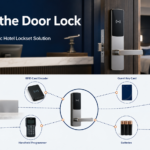
A typical installation may include:
Electronic hotel door locks
RFID or other compatible guest credentials
Card encoder
Lock management software
Staff or master cards
Portable programming or maintenance device
Batteries for individual locks
Mechanical emergency or override key
Compatible PMS integration where supported
Optional energy-saving switches or other hotel-access components
This is why hotels should evaluate a hotel locking system as a complete access environment, rather than selecting a door lock based only on appearance.
How Does a Hotel Lock System Work?
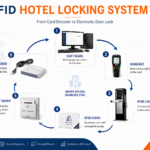
The easiest way to understand a hotel lock system is to follow what happens from reception to the guest-room door.
1. The Guest Checks In
At the front desk, hotel staff confirms the guest’s reservation and assigned room.
Depending on the hotel’s technology setup, this may happen in the PMS before the access credential is prepared.
2. The Key Card Is Programmed
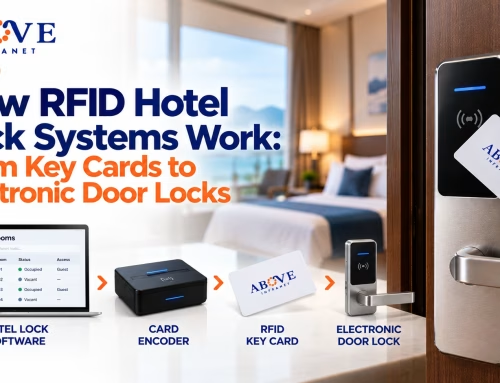
A card encoder communicates with the hotel lock management software to prepare the guest’s access credential.
The card can contain information that allows the appropriate lock to determine whether access is valid.
For example, access can be associated with:
The assigned room
Check-in period
Check-out or expiration period
Credential type
Relevant access permissions
3. The Guest Presents the Card to the Lock
With an RFID hotel lock, the guest normally holds or taps the card near the lock’s reader instead of inserting or swiping it.
The lock reads the credential and verifies whether it is authorized.
If the credential is valid, the door can be unlocked.
If it is invalid or expired, access can be denied.
4. Access Eventually Expires
Hotel credentials are designed around temporary access.
Once the authorized period ends or a card is replaced, depending on system behavior the old guest credential should no longer function as an active room key.
This is one of the major operational differences between electronic hotel lock systems and traditional mechanical keys.
What Are the Main Components of a Hotel Lock System?
Understanding the individual components helps hotels avoid a common procurement mistake: purchasing electronic locks without considering everything required to operate and maintain them.
The electronic lock is the physical device installed on the guest-room door.
Depending on the model and system, it may support technologies such as:
RFID
MIFARE-compatible credentials
Bluetooth
Mobile access
Other manufacturer-supported access technologies
The exact functions vary between manufacturers and models.
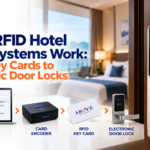
RFID Key Card
RFID stands for Radio Frequency Identification.
An RFID hotel card communicates with the lock using radio-frequency technology. Unlike older magnetic stripe cards, it generally does not need to be swiped through a reader.
Guests can simply present the credential near the lock.
For hotel operations, RFID cards can also be easier to issue and replace than traditional physical room keys.
Card Encoder
The encoder is normally located at reception or another controlled workstation.
Its role is to prepare compatible cards using the hotel lock software.
Without the appropriate encoder and management software, hotels cannot properly operate a card-based lock environment.
Hotel Lock Management Software
The management software controls the credential-issuing side of the system.
Depending on the product, authorized hotel personnel may use it to:
Identify rooms
Issue guest cards
Configure validity
Create different credential types
Manage users
Review available activity records
Perform administrative lock functions
The exact capabilities depend on the hotel-lock platform.
Staff and Master Credentials
Not everyone in a hotel should have the same access.
A well-planned hotel locking system can distinguish between different operational roles.
For example, housekeeping staff, maintenance personnel, supervisors, and hotel managers may each require different access permissions.
The important principle is role-based access: staff should receive only the access appropriate to their responsibilities.
Portable Programmer
Some hotel locking systems use a portable programming or maintenance device.
It may assist authorized technicians or hotel personnel with configuration, data retrieval, maintenance, or other manufacturer-supported functions.
Batteries
Many standalone electronic hotel locks are battery-powered.
That reduces the need to run power cabling to every individual guest-room door, but it also creates an important maintenance responsibility.
Hotels need procedures for:
Monitoring battery condition
Responding to low-battery warnings
Replacing batteries before failure
Keeping suitable replacement batteries available
Hotels should confirm the actual battery requirements and expected operating conditions of the specific model being considered rather than assuming all hotel locks perform the same way.
Mechanical Override
Electronic access should still have a documented contingency procedure.
Depending on the lock model, this may include a mechanical override key or another emergency access method.
Emergency-access policies should be controlled carefully so that backup access does not become a security weakness.
RFID, Magnetic Stripe, Mobile, or Biometric: Which Hotel Lock Is Right for You?
Not every hotel needs the same access technology.
Magnetic Stripe Locks
Magnetic stripe systems use cards containing data stored on a magnetic strip.
They have been widely used in hotels for many years, but the card normally needs to be swiped or inserted as designed by the system.
Existing properties may still operate these systems successfully, although hotels planning a significant modernization should compare them with newer alternatives.
RFID Hotel Locks
RFID hotel locks allow contactless card access.
Instead of swiping the card, guests normally present it near the lock reader.
For many hotels and resorts, RFID provides a practical balance between guest convenience and manageable hotel operations.
Mobile or Bluetooth Access
Some modern hotel locks offer Bluetooth or other mobile-access capabilities.
These systems may allow a compatible smartphone credential to unlock a room.
However, hotels should verify the complete technology stack before selecting mobile access. The door lock is only one part of the deployment; the software environment, credential delivery method, network requirements, PMS compatibility, and guest workflow can all affect implementation.
Biometric Access
Biometric systems use characteristics such as fingerprints or facial recognition for identification.
Although biometric access can be appropriate for certain controlled areas, hotels should carefully evaluate privacy, operating requirements, guest experience, and the intended use case before using biometrics for guestrooms.
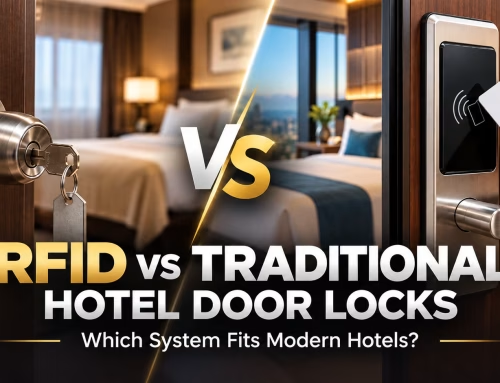
RFID vs. Magnetic Stripe Hotel Locks
Consideration
RFID
Magnetic Stripe
Guest action
Present or tap card near reader
Swipe or insert card depending on system
Contact with reader
Usually contactless
Usually physical
Hotel use
Common modern option
Established hotel technology
Credential replacement
Programmable
Programmable
Upgrade consideration
Suitable for many modernization projects
May remain suitable for existing installations
Integration
Depends on system
Depends on system
There is no universal answer for every hotel.
Existing infrastructure, project budget, desired guest experience, door conditions, operational workflow, and future technology plans should all be considered.
How Are Guest and Staff Access Different?
One of the biggest benefits of an electronic hotel lock environment is the ability to treat access as a managed permission rather than simply distributing physical keys.
Guest Access
A guest credential should typically be limited to the appropriate:
Room
Stay period
Permitted guest areas
Associated access privileges
Staff Access
Staff access is different.
A housekeeping employee, maintenance technician, front-desk employee, supervisor, and manager do not necessarily need access to the same rooms or areas.
Some systems therefore support different card classes or permission levels.
This allows hotels to design access policies around operational responsibility rather than giving every employee an unrestricted master key.
What Is an Audit Trail in a Hotel Lock System?
An audit trail is a record of access-related events stored by a compatible lock or management system.
Depending on the system, an audit record may contain information such as:
Date
Time
Credential or card identifier
Credential type
Room or lock identification
This information can help authorized hotel personnel investigate access-related questions.
For example, if management needs to review when a particular room was accessed, the lock system may provide activity information depending on the capabilities of the installed platform.
An audit trail does not replace proper hotel security procedures, CCTV, staff policies, or incident management. It is one part of the broader security environment.
Can a Hotel Lock System Integrate With a PMS?
Yes, some hotel lock systems can interface with Property Management Systems, but compatibility must be confirmed for the exact lock platform, PMS, software version, and supported interface.
A Property Management System manages operational functions such as:
Reservations
Room assignment
Check-in
Check-out
Guest information
Front-office processes
The hotel lock platform separately manages the access credential.
When compatible systems are integrated, the workflow may reduce the number of separate steps front-desk employees need to perform.
For Philippine hotels evaluating PMS integration, the correct question is therefore not simply:
“Does this lock integrate with a PMS?”
Instead ask:
“Does this exact hotel lock management system support our current PMS, software version, required interface, and intended workflow?”
Why Does PMS Compatibility Matter?
Without integration, front-desk employees may need to perform room-management and card-issuing steps in separate systems.
A compatible integration may make the process more coordinated.
For example, a normal workflow could involve:
Confirming the reservation
Assigning the room
Completing check-in
Creating the room access credential
Giving the credential to the guest
The objective is not technology for its own sake.
The goal is to make the guest-access process reliable and manageable for hotel employees.
What Should Hotels in the Philippines Consider Before Installing a Hotel Lock System?
Choosing a hotel lock system should begin with the property’s requirements not with the appearance of a particular lock.
1. Existing Doors
Check:
Door material
Door thickness
Existing lock preparation
Mortise requirements
Door orientation
Existing holes and hardware
Fire-rating considerations where applicable
Electronic locks have specific physical installation requirements.
A model that works on one door does not automatically fit another.
2. Number of Rooms and Access Points
A 20-room boutique hotel and a 300-room resort have very different operational needs.
Count not only guest rooms but also relevant areas such as:
Staff rooms
Offices
Storage rooms
Restricted areas
Elevators
Parking access
Amenities
Other controlled spaces
3. Credential Technology
Determine whether the property needs:
RFID cards
Mobile credentials
Existing magnetic cards
Staff credentials
Multi-area access
Avoid selecting a technology simply because it sounds more advanced.
Choose it because it supports the hotel’s actual operation.
4. Hotel Lock Management Software
Ask how employees will:
Issue cards
Replace lost cards
Handle extensions
Process room changes
Configure staff access
Retrieve activity information
Manage system users
The quality of the operating workflow matters as much as the hardware.
5. PMS Compatibility
If PMS integration is important, verify compatibility before purchasing the lock system.
Confirm:
PMS name
PMS version
Lock management software
Interface or integration method
Required licenses
Configuration requirements
Vendor responsibilities
Technical support arrangements
6. Lost Key Card Procedures
Hotels should establish what happens when a guest reports a lost card.
The replacement process should prevent an old credential from becoming an unnecessary security risk.
The exact process depends on the locking system.
7. Battery Maintenance
Ask:
What batteries are required?
Does the lock provide a low-battery warning?
How will staff monitor battery condition?
Who is responsible for replacement?
What happens if a battery reaches a critical level?
Battery maintenance should be part of the hotel’s preventive-maintenance schedule.
8. Emergency Access
Hotels need documented procedures for cases such as:
Electronic failure
Battery failure
Credential failure
Emergency room entry
Maintenance situations
Access to emergency tools and override credentials should itself be controlled.
9. Installation and Technical Support
A hotel lock deployment involves physical installation, system configuration, testing, employee orientation, and ongoing maintenance.
For properties with many doors, seemingly small installation inconsistencies can become operational problems at scale.
This makes planning and implementation important parts of the project not just the choice of lock.
When Should a Hotel Consider Upgrading Its Door Locks?
A hotel may want to evaluate its current lock system when:
Mechanical keys are difficult to control.
Lost physical keys create frequent rekeying concerns.
Existing electronic locks are becoming difficult to maintain.
Replacement cards or components are increasingly difficult to obtain.
The hotel is undergoing renovation.
Management wants better staff-access control.
Existing systems do not support desired hotel workflows.
The property is considering PMS-connected access.
The hotel wants to modernize the guest arrival experience.
An upgrade does not automatically mean installing the newest available technology.
Hotels should first identify the operational problem they are trying to solve.
Hotel Lock Systems Should Be Part of a Wider Security Strategy
Guest-room locks are important, but they should not be treated as the hotel’s entire security system.
A hotel may also rely on:
CCTV surveillance
Network infrastructure
Electronic access control
Front-desk procedures
Staff access policies
Emergency procedures
Visitor controls
Physical key management
IT security
Proper staff training
Hotel security works best when these systems and procedures are planned together.
This systems-level approach is particularly relevant for hotels and resorts modernizing several parts of their infrastructure at the same time.
How to Choose a Hotel Lock System Provider in the Philippines
Hotels should evaluate a provider based on more than the number of available lock designs.
Ask prospective providers:
Can you assess our existing doors before finalizing the solution?
Which access technologies do you support?
What equipment is included in the complete system?
How are guest cards encoded?
What staff-access levels are available?
Does the system provide access records or audit trails?
How are lost cards handled?
What happens when a lock battery becomes low?
What emergency-access options are available?
Can the system work with our existing PMS?
Who verifies PMS compatibility?
What installation work is required?
Is staff training included?
What technical support is available after installation?
Are replacement parts and compatible cards readily available?
A detailed answer to these questions can reveal more about a system’s suitability than simply comparing lock appearance or price.
Building a Better Hotel Access System
The right hotel lock system in the Philippines should do more than replace a mechanical key.
It should give the hotel a manageable way to issue guest access, control staff permissions, replace credentials, maintain the locks, review available access information, and support day-to-day hotel operations.
That is why hotel owners and managers should evaluate the complete locking environment door hardware, RFID credentials, encoder, software, access policies, PMS compatibility, maintenance procedures, and technical support before deciding which solution to deploy.
For more information on how Above Infranet Solutions Inc can help you with Hotel Lock System Philippines: A Guide for Hotels and Resorts, please contact us at 0917 715 4189, or visit us here: